
This section focuses on practical support – things you can use in everyday life. Whether you’re filling out forms, supporting your child at home, or looking for ideas to help with routines and learning, these resources are here to help you.

Where would you like to start?

Forms are often one of the most challenging parts of this process. They can feel long, repetitive, and difficult to complete – especially when you’re unsure what information is most important or what they are actually asking you. This section breaks down some of the key forms you may come across, along with guidance to help you approach them with more confidence.
Children’s Services Referral Form (CDNT)
This form is used to refer your child to a CDNT for support services. The CDNT you refer your child to will be based on your child’s home address.
What It’s For:
– Requesting access to public disability services
– Starting the process of assessment and support
What You’ll Be Asked:
– Your child’s developmental history
– Current concerns
– Communication, behaviour, and daily living skills
– Reports from professionals (if available)
Helpful Tips:
– Try to describe your child’s needs clearly and honestly
– Focus on day-to-day challenges
– Include examples where possible
– Don’t worry about using ‘perfect’ wording
It’s okay if you don’t have every detail – this is just the starting point.
Additional Information Form
This form is sometimes requested alongside referrals or assessments to provide more detailed information about your child. It helps to give a fuller picture of your child’s needs and can help to supplement applications for services or supports.
Helpful Tips:
– Take your time – this form can feel detailed
– Break it into sections rather than doing it all at once
– Include examples from daily life
The more clearly your child’s needs are described, the easier it is for professionals to understand how to support them.
Assessment of Need (AON)
This form is used to apply for an Assessment of Need under the Disability Act 2005. This process is separate from CDNT referrals, and both can be pursued if needed.
What It’s For:
– Requesting a formal assessment of your child’s needs
– Receiving a report outlining required supports
What You’ll Be Asked:
– Yours and your child’s details
– Reason for the application
– Education information (if applicable)
– Supporting documents (such as a referral from your GP or reports from professionals)
Helpful Tips:
– You do not need a diagnosis to apply
– Include any reports or observations you already have
– Keep a copy of your application for your records
School Support Form
Schools may use different forms to apply for additional supports for your child.
What These May Include:
– Applications for special education supports
– Requests for additional needs assistance
– Documentation for accessing special classes or placements
Helpful Tips:
– Work closely with your child’s teacher or school
– Share any reports or assessments you have
– Ask questions if anything is unclear
Schools are often familiar with this process and can guide you through it. However, if you ever need help with any specific forms, NeuroNest is always here to help.
Most forms are not about getting everything ‘right’ – they are about helping others understand your child. You can take your time filling out these forms, even filling them in over a few sittings – this can help reduce the overwhelm, and often things will come to you after. You don’t need to do this perfectly – just honestly – and don’t be afraid to ask for help.
Helpful Tip: keep your own personal copy of everything you submit.
Financial supports can make a meaningful difference – but understanding what’s available and how to apply can feel confusing. This section breaks down some of the key supports available to families of autistic children, with clear guidance to help you take the next step.
Medical Card / GP Visit Card
A Medical Card or GP Visit Card can help with the cost of healthcare for your child. A Medical Card covers GP visits, hospital care, and some therapies. A GP Visit Card covers free GP visits only. Applications are assessed by the HSE. Having a diagnosis or significant needs may support your application.
You apply for both a Medical Card and GP Visit Card on the same form. You will be given whichever card you are entitled to. It’s important to note that all children under the age of 8 are entitled to a GP Visit Card.
To Be Eligible:
– You must be certain income criteria, or your child certain medical criteria
– Children with additional needs may qualify based on medical need, even if income is above the usual limits
– You must be habitually resident in Ireland
How To Apply?
1. Apply online through the HSE website or by paper form
2. Provide details about your child and household income
3. Include medical information if relevant
4. Submit application and await decision
Helpful Tip: If your child has additional needs, it’s worth applying even if you think your income may be too high – medical eligibility can sometimes apply.
School Transport Scheme
The School Transport Scheme provides transport to and from school for children who qualify. Eligibility depends on placement and location. The scheme is managed by Bus Éireann on behalf of the Department of Education.
To Be Eligible:
– Your child must be attending: a special school, a special class, or the nearest suitable school placement
– Distance and specific criteria may apply
How To Apply?
1. Apply online through Bus Éireann (School Transport section)
2. Provide details of your child’s school placement
3. Await confirmation of eligibility
Helpful Tip: If your child receives a school placement, it’s worth checking transport options early, as timelines can be important.
Home Tuition Grant
The Home Tuition Grant is provided by the Department of Education to support children who are unable to attend school or are waiting for a suitable placement. Approval is required before starting but once approved, funding can be used to hire a qualified tutor to work with your child in your home. This is often used as a temporary measure.
To Be Eligible:
– Your child does not have a school place, or cannot attend school
– Your child has additional needs (including autism)
– Supporting documentation is required
How to Apply?
1. Contact your local SENO to discuss your child’s situation and eligibility
2. Gather documentation (such as medical reports, psychological assessments, evidence of need)
3. Complete and submit the required form through the Department of Education
4. Once approved, you can hire a tutor with appropriate qualifications and experience
Helpful Tip: If your child is out of school or struggling to access a placement, this can be an important support to explore early.
Need Help Finding a Tutor? You can browse our directory of tutors who specialise in working with autistic children and providing home tuition support.
Domiciliary Care Allowance (DCA)
The Domiciliary Care Allowance (DCA) is a monthly payment from the Department of Social Protection for parents or guardians of children with a severe disability. This is often the main support families apply for first. It is not means-tested, which means your income does not usually affect eligibility.
To Be Eligible:
– Your child must be under 16 years old
– Both you and your child must be habitually resident in Ireland
– Your child must have a disability that is severe, has lasted (or is expected to last) at least 12 months, and requires substantially more care and attention than a child of the same age
The Department of Social Protection looks at the level of care your child needs in areas such as:
– Personal care (feeding, dressing, hygiene)
– Mobility and supervision needs
– Medical care and therapies
– Behavioural supervision
– Communication
How to Apply?
1. Complete the DCA1 form (available on Citizens Information or MyWelfare)
2. Complete the sections of the form that you can
3. Ask your GP or specialist to complete the medical section
4. Submit application to Domiciliary Care Allowance Section, Social Welfare Services Office
Helpful Tip: When completing the form, it can help to describe your child on their most challenging days, rather than their best days. This gives a clearer picture of the level of support they need.
Incapacitated Child Tax Credit
The Incapacitated Child Tax Credit is a tax credit that can reduce the amount of tax you pay if your child has a long-term condition requiring ongoing care. This is not a direct payment, but instead reduces your tax. You can apply for this through Revenue. Medical certification is required.
To Be Eligible:
– Your child must have a long-term physical or mental condition
– The condition must require ongoing care or supervision
– You must be paying tax in Ireland
How To Apply?
1. Apply through Revenue (online via MyAccount or by form)
2. Provide medical certification confirming your child’s condition
3. Submit supporting details as requested
Helpful Tip: Like many tax credits, this is often overlooked, but it can make a meaningful difference over time.
Carer’s Allowance
Carer’s Allowance is a weekly payment for people who are providing full-time care to someone who needs significant support. This is a means-tested payment, meaning your income must fall within certain limits. You must not be engaged in full-time employment and may be able to work or study for limited hours while receiving this.
To Be Eligible:
– You must be providing full-time care and attention
– Your child must require ongoing supervision or support
– You must be habitually resident in Ireland
How to Apply?
1. Complete the Carer’s Allowance application form (available on Citizens Information or MyWelfare)
2. Provide details about your child’s care needs
3. Submit supporting medical information if required
Helpful Tip: Even if you are unsure whether you qualify due to income, it can still be worth applying or seeking advice – many families are unsure at first.
Carer’s Benefit
Carer’s Benefit is a payment for people who leave work temporarily (or reduce their hours) to care for someone who needs full-time care. Unlike Carer’s allowance, this is not a means-tested payment and relies on your PRSI contributions instead.
To Be Eligible:
– You must have been working and paying PRSI contributions before becoming a carer
– You must be providing full-time care and attention
– Your child must require ongoing supervision or support
– You must be habitually resident in Ireland
How To Apply?
1. Complete the Carer’s Benefit application form (available through Citizens Information or MyWelfare)
2. Provide details of your previous employment and PRSI contributions
3. Submit medical information confirming your child’s care needs
Helpful Tip: If you have recently left work (or are considering it) to care for your child, it’s worth checking this before Carer’s Allowance, as the eligibility criteria are different.
Carer’s Support Grant
The Carer’s Support Grant is a once-off yearly payment for carers. This is not a means-tested payment. It is usually paid automatically if you are receiving Carer’s Allowance. However, some carers may still qualify even if they are not receiving Carer’s Allowance.
To Be Eligible:
– You must be providing full-time care to a child who requires ongoing support
– You must meet residency requirements
How To Apply?
1. If you are getting Carer’s Benefit/Allowance or Domiciliary Care Allowance, you do not need to apply
2. If not, you can fill in the Carer’s Support Grant Application Form (available on Citizens Information or MyWelfare)
Helpful Tip: If you are caring for your child full-time, it is worth checking your eligibility – even if you are not receiving other payments.
Housing Adaptation Grant
This grant helps cover the cost of making changes to your home if your child has additional needs. Funding depends on income and level of need. It can be used for things like: sensory-friendly spaces, safety adaptations, or bathroom modifications. The grant is managed through your local authority (council).
To Be Eligible:
– Your child must have a disability that impacts their mobility or daily functioning
– You must own your home or have permission from the landlord
– The home must be your main residence
– Your income is assessed (means-tested)
How To Apply?
1. Contact your local authority for an application form
2. Provide medical evidence of your child’s needs
3. Submit quotes for the work required
4. Application is assessed and approved before work begins
Helpful Tip: Even small changes to the home can make a big difference – this support can help make everyday life more manageable.
Applying for supports can take time, and the process isn’t always straightforward. You don’t need to explore all of these at once. Many families come back to this information over time, as their child’s needs and circumstances change.
Learning doesn’t need to look like formal teaching. For many children, the most meaningful learning happens through everyday experiences – getting dressed, playing, moving, and being part of daily routines. You don’t need to recreate a classroom at home. What matters most is creating opportunities for your child to learn in ways that feel natural and manageable for them.
Every child learns differently, and there is no single ‘right’ way to teach. Some children benefit from repetition and routine, while others learn best through movement, play, or hands-on experiences. It’s okay to follow your child’s pace and adjust your approach as you go.
Living Skills
Many important skills develop through daily routines. Getting dressed, putting on shoes, tidying toys, or helping with small tasks are all opportunities for learning. These moments may seem small, but over time they build confidence, understanding, and independence. Breaking tasks into simple steps, allowing extra time, and repeating them regularly can make these routines easier to learn.
Examples might include:
– Helping with simple tasks (e.g. tidying toys)
– Getting dressed
– Putting on shoes
– Washing hands
While things like brushing teeth, toileting, and bathing can be included but these can often be difficult and overwhelming for autistic children. If this is the case for your child, this is totally normal. We have resources to help you approach teaching these, and making them easier for your child.
Independent Skills
Independence develops gradually, through small and repeated experiences. This might begin with simple choices, such as choosing between two options, or taking part in small parts of a routine. Over time, with support and encouragement, children can begin to complete more tasks on their own. It’s okay if this takes time – progress often happens in small steps.
Examples may include:
– Gradually reducing help over time
– Following simple routines
– Making choices (e.g. choosing between two options)
– Completing small tasks with support
Fine Motor Skills
Fine motor skills involve small hand movements that support tasks like drawing, feeding, and dressing. These skills often develop through simple, hands-on activities such as using crayons, playing with playdough, completing puzzles, or stacking and sorting objects. There is no need to push for perfection – exploring and practising is enough.
Examples might include:
– Threading or stacking toys
– Drawing or colouring
– Using crayons, chalk, or markers
– Playing with playdough
– Simple puzzles
Gross Motor Skills
Movement is an important part of learning and development. Activities like running, jumping, and climbing help build strength, coordination, and body awareness. For many children, movement also supports focus, regulation, and overall wellbeing.
Examples might include:
– Dancing or movement games
– Running, jumping, or climbing
– Playing in the park
– Throwing and catching a ball
Learning Through Everyday Activities
Many of the most valuable learning opportunities happen naturally. Learning doesn’t need to feel like ‘work’ – it can be part of everyday moments.
Play is one of the most powerful ways that children learn. Simple interactions – like taking turns, naming objects, or following your child’s interests – can support communication, attention, and understanding. These moments don’t need to be structured or planned. Being present and responsive is often enough.
Examples may include:
– Practicing turn-taking in games
– Counting while putting toys away
– Naming items during play
– Following simple instructions during routines
Supporting Focus & Engagement
It’s common for children to move quickly between activities or find it difficult to stay with something for long. Keeping activities short, following your child’s interests, and allowing movement breaks can help support engagement. What matters most is that your child feels comfortable and involved, rather than completing a task from start to finish.
More practical resources are on the way...
We’re continuing to create simple tools and visuals to support everyday skills, independence, development, and learning at home. These will include tools and visuals for areas such as self-care, daily routines, fine motor skills, and gross motor skills.
You don’t need to do everything at once. Learning happens over time, through small, repeated experiences. What matters most is creating a supportive environment where your child feels understood, encouraged, and able to learn in their own way.
Many children benefit from clear, predictable routines. For autistic children in particular, knowing what to expect can help reduce anxiety, support understanding, and make everyday activities feel more manageable.
Why Routines Matter:
– They help create a sense of safety and predictability
– They can reduce uncertainty and anxiety
– They support communication and understanding
– They can make transitions between activities easier
– They help to build independence over time
Even simple routines can have a big impact. You don’t need a strict schedule – just a consistent and predictable flow to the day. We will provide blank visuals that you can print out to use at home to help with your routines and transitions.
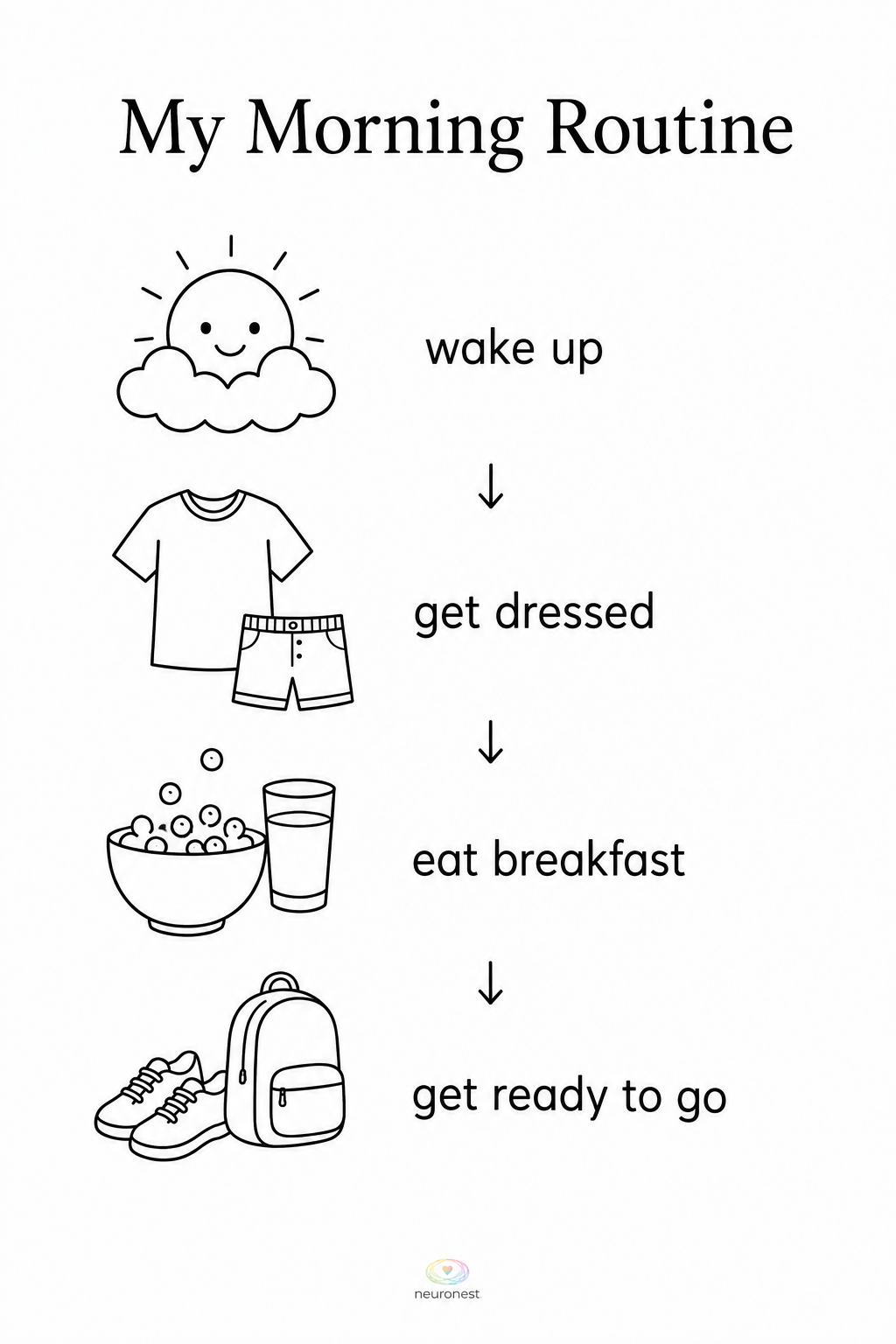
Morning Routine
You might include things like:
– Waking up
– Getting dressed
– Breakfast
– Brushing teeth
– Getting ready to leave
Helpful Ideas:
– Give extra time where needed
– Keep steps in the same order each day
– Use clear, simple language
Morning Routine Example

Editable Morning Routine

Bedtime Routine
A consistent bedtime routine can help your child feel more calm and prepared for sleep.
You might include things like:
– Bath or wash
– Pyjamas
– Bedtime story
– Sleep time
Helpful Ideas:
– Keep the routine calm and predictable
– Use the same steps each night
– Reduce noise and stimulation before bed
Bedtime Routine Example

Editable Bedtime Routine

Mealtimes
Mealtimes can sometimes be challenging, especially if your child has sensory sensitivities.
Helpful Ideas:
– Keep mealtimes consistent
– Keep plate/utensils the same
– Use sticks if your child doesn’t like touching food
– Offer familiar foods alongside new ones
– When trying new foods, also try present them in different ways
– Avoid pressure – gentle exposure is enough
Transitions
Transitions (moving from one activity to another) can be one of the most challenging parts of the day for autistic children.
Give Advance Notice
– Let your child know what is coming next
– Use simple phrases like: “in five minutes, we’re going to tidy up”
– Make sure to give multiple reminders of the transition
– Before ending the activity, it is a good idea to give a “5,4,3,2,1” countdown (pairing this visually with your fingers counting down is also helpful).
Use Consistent Language
– Repeat the same phrases for transitions (“in five minutes”, “in two minutes”, “in one minute”)
– Keep instructions clear and simple
Break It Down
– Instead of one big instruction, use smaller steps
– For example: “tidy toys” → “shoes on” → “coat on”
Use Visual Supports
– Visual supports can be extremely helpful
– First/Then boards, picture schedules, visual timers
– These can make expectations clearer and easier to understand
Transitions can be difficult, and it’s okay if they don’t always go smoothly. The most important thing is to stay calm, stay consistent, offer reassurance, and allow plenty of time for adjustment.
First-Then Board Example

Editable First-Then Board

There is no perfect routine, and what works will be unique to your child. It’s okay to start small – one routine, one change, one step at a time.
Play is an essential part of a child’s life. It is also one of the most natural ways children learn, connect, and communicate. For autistic children, play might look a little different but it is still a meaningful and important way of understanding the world. You don’t need special training or materials – small, simple interactions can make a big difference.
Understanding Play
Every child plays in their own way. Your child’s way of playing may look a little different, and that’s okay. There is no right or wrong way to play. Even if it looks different, your child’s play is meaningful, enjoyable, and important to them. What matters most is recognising and valuing how your child chooses to play, rather than trying to change it.
Building Connection Through Play
Connection comes before communication. You can support this by: joining your child in what they are already doing, simply sitting nearby and observing, or following their interests, rather than directing the play. Even small moments of shared attention are meaningful.
Simple Ways To Support Play
Follow Their Lead:
– Let your child choose the activity
– Join in without changing it too quickly
– This helps your child feel understood and comfortable
Repeat & Expand:
– Copy what your child is doing
– Then gently add something small
– For example, if they are stacking blocks → add one more or if they make a sound → repeat it back
Keep It Simple:
– Use short phrases
– Give your child time to respond
– Avoid asking too many questions
– Pauses are important – give your child time to process
Make It Enjoyable:
– Use facial expressions and gestures
– Show interest and enthusiasm
– Keep interactions playful and relaxed
Joint Attention
Joint attention is when you and your child are both focused on the same thing at the same time – like a toy, activity, or moment. This is an important foundation for communication. Even brief moments of shared attention are valuable.
How To Support It:
– Sit at your child’s level
– Follow what they are looking at
– Point things out gently
– Use simple words
– Example: “Look – bubble!”
Turn Taking
Turn-taking helps build interaction and communication.
Ways To Practice:
– Taking turns with bubbles
– Rolling a ball
– Taking turns stacking blocks or pushing cars
– Simple games like “ready, steady, go”
– Songs like 5 Little Monkeys, 5 Green Speckled Frogs where one person does the action then the next
Helpful Tip: keep turns short and predictable, and use the same words each time (example: “my turn” → “your turn”).
Play Ideas
Every child is at a different stage in their play. You don’t need to move ahead too quickly – start where your child is comfortable, and build from there.
Early Play (Exploring & Sensory Play)
At this stage, children are exploring how things feel, look, and sound.
Ideas:
– Playing with water (pouring, splashing, cups)
– Sensory bins (rice, pasta, sand)
– Spinning objects (wheels, lids, toys)
– Cause-and-effect toys (buttons, pop-up toys)
– Lights, bubbles, or music toys
Your Role:
– Join gently without interrupting
– Sit nearby
– Notice what they enjoy
Developing Play (Repetition & Interaction)
Children may begin to repeat actions and tolerate shared play.
Ideas:
– Building and knocking down towers
– Rolling a ball back and forth
– Simple insert puzzles
– Posting games (putting objects into containers)
– Shape sorters
Your Role:
– Copy what they do
– Add small changes
– Create simple back-and-forth moments
Expanding Play (Imagination & Interaction)
Some children begin to explore pretend or shared play.
Ideas:
– Feeding a doll or teddy
– Toy kitchens
– Cars and small worlds
– Dressing up
– Simple role play (shop, doctor, chef)
Your Role:
– Keep it simple
– Follow their interest
– Don’t force pretend play – let it develop naturally
Sensory Play
Sensory play can help children explore, regulate, and feel more comfortable in their environment.
Tactile (Touch)
Sand, rice, pasta bins
Playdough or slime
Water play
Finger painting
Auditory (Sound)
Musical toys
Singing songs
Clapping or tapping games
Listening to favourite sounds
Visual
Bubbles
Lava lamps or light toys
Colour sorting
Watching moving objects
Movement (Vestibular / Proprioceptive)
Swinging
Jumping on a trampoline
Rolling on the floor
Pushing/pulling toys
Watch how your child responds – some children seek sensory input, while others may feel overwhelmed. Follow their lead and adjust activities based on what feels comfortable for them.
Engagement Strategies
Engagement is about helping your child feel interested, comfortable, and connected.
Ways to Support Engagement:
– Repeat familiar activities
– Follow your child’s interest
– Be present and responsive
– Keep activities simple
– Use enthusiasm and expression
You don’t need to lead the play – just being involved and responsive is enough.
You don’t need to try everything at once. Start with one activity, follow your child’s lead, and build from there. Small, shared moments of play can have a lasting impact.
Communication is more than words. Children communicate in many different ways – through sounds, gestures, facial expressions, and behaviour. Your child may be communicating more than it first appears.
Understanding Communication
Every child develops communication in their own way and at their own pace. Some children use words, while others may communicate by pointing, bringing objects, making sounds, or showing you what they need through their actions. All of these are meaningful forms of communication.
Connection Comes First
Before communication develops, children need to feel connected and understood. This often begins in small, everyday moments – sitting nearby, noticing what your child is interested in, and responding to it. When a child feels understood, they are more likely to communicate again.
Supporting Communication in Everyday Moments
You don’t need to set aside special time to work on communication – it happens naturally throughout the day. Using simple, clear language can make a big difference. Short phrases like “shoes on” or “more juice” are easier to understand than longer sentences. It can also help to pause after speaking. Giving your child time to process and respond – without rushing or repeating – creates space for communication to happen.
Modelling Language
One of the most effective ways to support communication is simply by modelling language. This means saying the word or phrase your child might use, without asking them to repeat it. For example, if your child reaches for juice, you might say ‘juice‘ rather than asking a question and then handing them the juice – without the expectation of them repeating the word. Over time, hearing language used in meaningful moments helps children begin to use it themselves.
Making Communication Clear
Pairing words with actions, gestures, or showing objects can make communication easier to understand. For some children, visual supports such as pictures or simple “first/then” boards can also help make expectations clearer and reduce frustration.
Creating Opportunities
Sometimes small pauses in familiar activities can create natural opportunities for communication. For example, pausing before giving a favourite toy, or waiting briefly during a game or song, can give your child a chance to respond in their own way. These moments don’t need to be forced – just gently noticed.
Valuing All Communication
Not all children will use spoken language, and some may communicate in ways that look different. What matters most is that your child has a way to express themselves and be understood. Every attempt – whether it’s a sound, gesture, or action – is meaningful and worth responding to.
Alternative Communication
Some children need extra support to help them communicate, and there are lots of ways to do this. This might include hand signs (Lámh), pictures, communication boards, or a communication device. These supports don’t need to be a last resort or something you wait for until speech develops – they can give your child a way to communicate right now.
Communication happens all through the day, not just during teaching or therapy. Mealtimes, play, getting dressed, going out, or choosing what to do can all be opportunities to communicate. You can model a word, sign, picture, or symbol without expecting your child to copy you or use it straight away. Even if they don’t respond, they are still seeing and learning how that way of communicating can be used.
Your child doesn’t need to be speaking, pointing, copying, or using a communication system already before they can have support. Some children will develop more spoken language over time, while others may continue to use AAC or a combination of different ways to communicate. There is no right or wrong way to communicate, what matters is that your child has a way to express themselves and be understood.
What is Lámh?
Lámh is a simple sign system used in Ireland to support communication. It uses hand signs to represent common words, such as: more, help, stop, eat, drink. It is always used alongside speech, not instead of it. Using these signs can reduce frustration, support understanding, give your child a way to communicate, and support the development of spoken language.
Lámh can be helpful for children who are not yet using words, are using a small number of words, find it difficult to express their needs, or who benefit from visual and physical supports.
Where Do I Start?
You don’t need to learn lots of signs at once, start with just a few key words. Choose words your child needs most, such as: more, help, finished, play, eat, drink. It is helpful to use signs during everyday routines such as: mealtimes, play, getting dressed, or transitions. It is important to always pair the sign with the word – Lámh supports speech, it doesn’t replace it.
Make sure to keep it consistent – use the same signs regularly, repeat them often, and keep it simple.
Follow Your Child’s Lead
Some children will copy signs quickly, others take time to use them. All of this is part of the process.
Do I Need to Be Perfect?
Absolutely not, just as you wouldn’t expect your child to be perfect! Your signs don’t need to be exact. What matters most is consistency, connection, and making communication easier.
Where to Learn More
You can learn Lámh through:
– Lámh training courses
– Videos and online resources
– Guidance from speech and language therapists
What is PECS?
PECS (Picture Exchange Communication System) uses pictures to help children communicate. At the beginning, this will look like your child handing you a picture of something and you giving it to them. This helps your child learn that this gets a response.
What are Communication Devices?
AAC (Augmentative and Alternative Communication) Devices include apps that allow children to communicate using pictures, symbols, or words. This might look like tapping a picture on a tablet, selecting words to build simple sentences, or using a device alongside gestures or speech.
Core Words and Communication Resources
Communication systems can include words that are useful in lots of different situations, often called core words, alongside words that are personal and meaningful to your child – such as favourite people, foods, places, activities, or things they enjoy.
Some children may use a core board, which provides commonly used words that can support communication throughout the day. There are lots of great free printable communication resources available online, including core boards and other low-tech AAC supports.
You might find these resources helpful:
Where Do I Start?
Starting does not need to be complicated. Begin with motivation, communication starts with what your child wants. Make sure to start small with only one picture and simple choices (you can build on this later). It’s important to stay consistent – the goal is to build understanding. Use the same pictures, same words, and same routines.
Model, Don’t Test
Show your child how to use it: point to the picture, say the word, respond immediately.
Will This Stop My Child Talking?
This is a very common worry, but using PECS or a device does not stop a child from developing speech. In many cases, it reduces frustration, builds understanding, and supports language development.
How It Can Grow Over Time
Communication supports can develop with your child. You might see your child:
– moving from single pictures → choices
– building simple combinations
– using more words or symbols
– combining speech with visuals
Some children may move toward more spoken language, or continue using AAC as their main form of communication. Both are valid.
Support and Guidance
If you are unsure where to begin, a Speech and Language Therapist can guide you on what system suits your child, help set up supports, and show you how to use them in everyday life.
AAC Support in Ireland
AsIAm offers an AAC Support Programme for autistic children who may benefit from a high-tech communication device. Depending on a child’s circumstances and whether they are already working with a Speech and Language Therapist, the programme can provide different pathways for accessing, trialling, and receiving support with AAC devices. The programme has specific eligibility criteria and availability can change, so it’s best to check the current information directly with AsIAm.
Want to Learn More About AAC?
If you’d like to learn more about AAC, the AAC Learning Center offers free online courses covering topics including an introduction to AAC for children, developing AAC systems, and visual supports for communication. Some of the learning is aimed at students and professionals, but the resources are also available to family members who want to build their understanding of AAC.
Giving your child a way to communicate is not about replacing speech, it’s about making sure they have a way to express themselves in whatever form works best for them. Some children may develop more spoken language over time, while others may continue using AAC as their main form of communication. Both are valid.
Communication Toolkit
These simple tools can support your child to express their needs, make choices, and communicate in a way that works for them. You don’t need to use everything – start with what feels manageable.

Twinkl AAC Symbols
Twinkl Symbols offers ready-made communication boards and visual supports, as well as tools to create and personalise your own. It can be a useful place to explore different ways of supporting communication and finding what works for your child. The mobile app is free to download, links are included below.

Download the Twinkl App here:
Lámh Signs
Lámh is a key word signing system used in Ireland to support communication. Signs can be used alongside speech to help children understand and express themselves.
You can explore the Lámh Signs Library to look up individual signs and find resources to support learning and practising them. The site has a searchable signs library, and their resources include things like Sign of the Week and videos/resources for practising signs.
Picture Communication Cards
A set of printable picture cards that can be used in different ways to support communication. They can be used for making choices, expressing needs and wants, building vocabulary, or as part of a picture-based communication system such as PECS.
There is no single ‘right’ way to communicate. What matters most is that your child feels understood, supported, and able to express themselves in their own way. Small, consistent interactions throughout the day can make a meaningful difference over time.
You might notice your child:
– Covering their ears
– Seeking movement (running, jumping, spinning)
– Avoiding certain textures or foods
– Becoming overwhelmed in busy environments
– Needing quiet time after social or sensory demands
Children experience the world through their senses and for many autistic children, this experience can feel more intense, less predictable, or harder to organise. Children experience the world through their senses – and for many autistic children, this experience can feel more intense, less predictable, or harder to organise.
These are not behaviours to ‘fix’, they are how your child responds to how their body and environment feel.
Understanding Sensory Differences
Every child processes sensory information differently. Some children may be: more sensitive (easily overwhelmed by sound, light, touch); less sensitive (seeking more movement, pressure, or input); or a mix of both, depending on the situation.
This can affect: attention, behaviour, emotions, and energy levels throughout the day. What might look like difficult behaviour is often your child trying to communicate or manage how they feel.
What is Regulation?
Regulation is your child’s ability to feel calm, alert, and comfortable in their body. All children move in and out of different states during the day. Some moments feel settled and organised, while others feel overwhelming or unsettled. Autistic children may need more support to move between these states.
Supporting Regulation in Everyday Life:
There is no one approach that works for every child. The goal is to gently understand what helps your child feel more settled.
Some children benefit from:
– Movement (jumping; climbing; swinging; walks; or heavy work like pushing/pulling a box).
– Sensory Comfort (weighted blankets; low-stimulation spaces; familiar textures or objects).
– Predictability (simple routines; visual supports; knowing what’s coming next).
– Time to Recover (breaks after busy/overwhelming activities; space to be alone, or in a calm environment).
Co-Regulation (You Matter Too!)
Children learn to regulate through connection with others. Your calm presence, voice, and response can help your child feel safe and supported – even when they are overwhelmed.
This might look like:
– Sitting nearby without pressure
– Using a calm, steady voice
– Giving space when needed
– Gently supporting rather than directing
Regulation in Overwhelming Moments:
There will be times when your child feels overwhelmed. In these moments, the goal is not to stop the behaviour – but to help your child feel safe and supported. These moments are not something your child is choosing – they are a sign that something feels too much. Your role is not to control the moment, but to support your child through it.
Keep Things Simple:
– Reduce talking
– Use a calm, steady voice
– Avoid giving lots of instructions
Reduce Sensory Input:
– Move to a quieter space
– Dim lights if possible
– Remove extra noise or distractions
Offer Comfort (if welcomed):
– Sit nearby
– Offer a familiar object (like a blanket or favourite toy)
– Use gentle pressure or touch (if your child finds this helpful)
Allow Time:
– Regulation takes time
– Stay present rather than trying to ‘fix’ it quickly
– Avoid rushing the moment
– Give space for your child to recover
After The Moment:
Once your child is calm, you can gently reflect or move on. There is no need to revisit everything straight away – sometimes simply returning to a calm activity is enough.
Sensory Activites
Sensory activities can help your child feel more settled, more alert, or more comfortable in their body. Every child is different, so it can take time to notice what your child is drawn to and what helps them feel at ease.
Calming, Low-Stimulation Activities
Reading together
Colouring
Puzzles or simple repetitive play
Soft toys
Environmental / Sensory Modification
Reducing noise (ear defenders)
Dim lighting
Soft music / white noise
Reducing strong odours
Vestibular (Movement / Balance)
Jumping on a trampoline or bed
Swinging or sliding
Rocking in a chair
Spinning
Hanging upside down
Proprioceptive (Deep Pressure & Heavy Work)
Tight hugs (if your child enjoys them)
Weighted blankets or lap pads
Burrito wrap in blanket
Pushing or pulling (laundry basket, toys, boxes)
Pushing hands together or against a wall
Oral & Chewing Input
Crunchy or chewy snacks
Drinking through a straw
Chewable toys (if appropriate)
Blowing bubbles
Tactile (Touch)
Playdough
Sensory bins (water, rice, sand)
Fidget toys
Massage
There is no perfect way to support sensory needs. What matters most is: noticing patterns, responding with curiosity and empathy, and giving your child space to be themselves. Over time, you will begin to understand what helps your child feel more comfortable and regulated.
Supporting regulation is not about changing your child – it’s about understanding what helps them feel safe, calm, and able to engage with the world around them.
Helpful Tools
If you’re not sure where to begin, these tools are a good place to start. They can help your child understand what’s happening and give them a sense of control in everyday moments. These tools are here to gently support communication, routines, and understanding. You don’t need to use everything – start with what feels manageable and most useful.
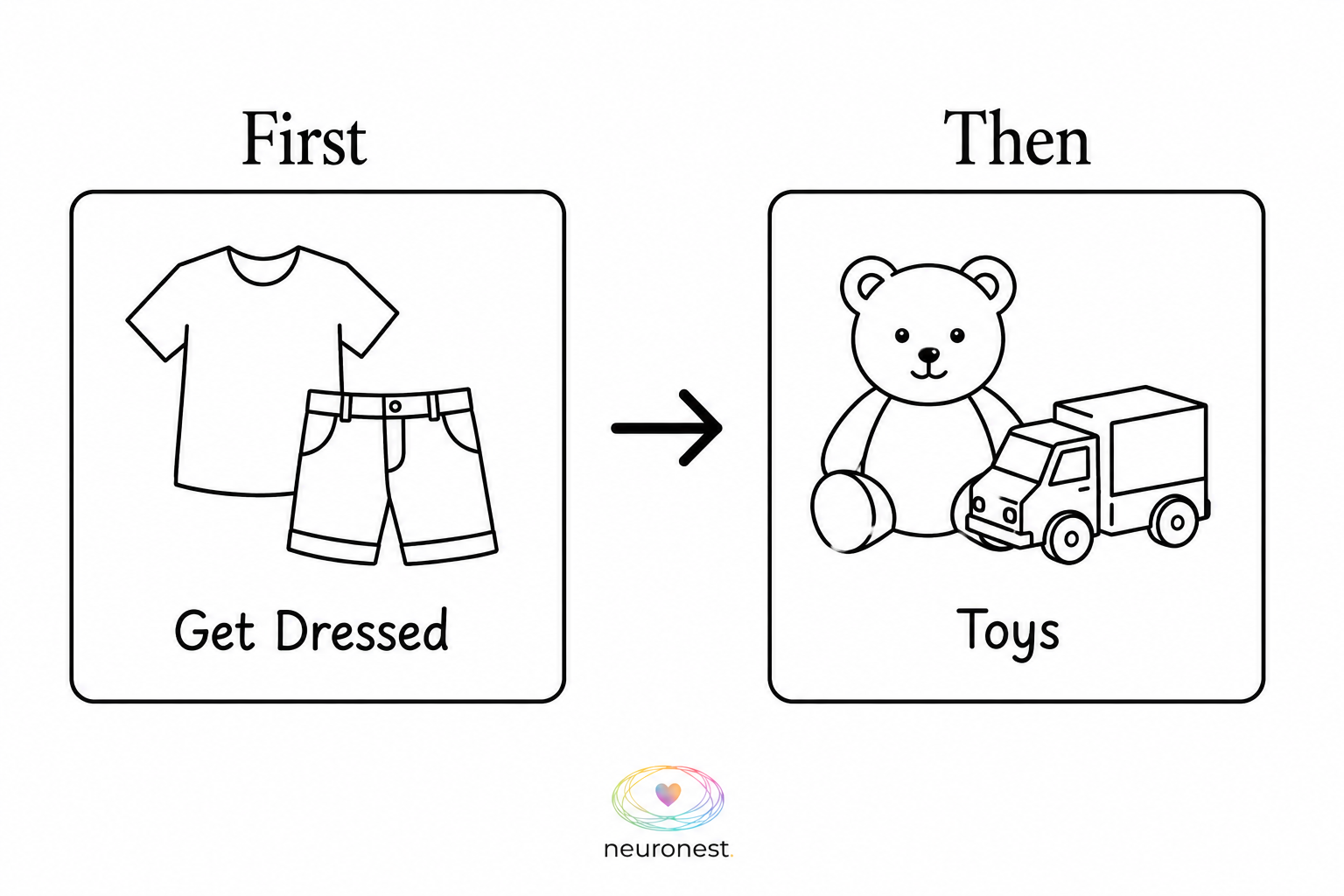
First-Then
A simple way to show what is happening now and what will come next. This can make transitions feel clearer and more manageable.

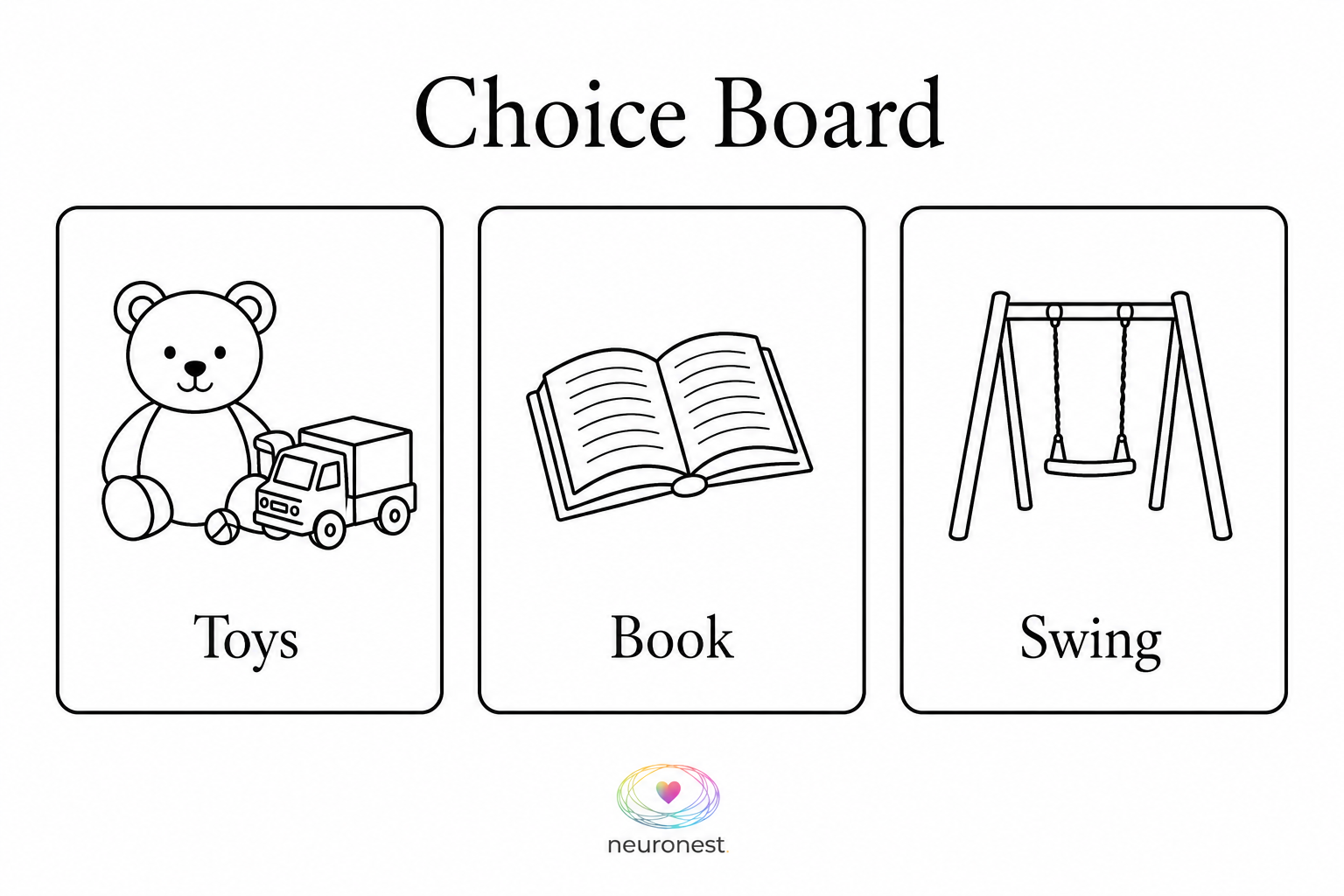
Choice Board
Offering choices can reduce frustration and support communication. This tool allows your child to choose between options in a clear, visual way.
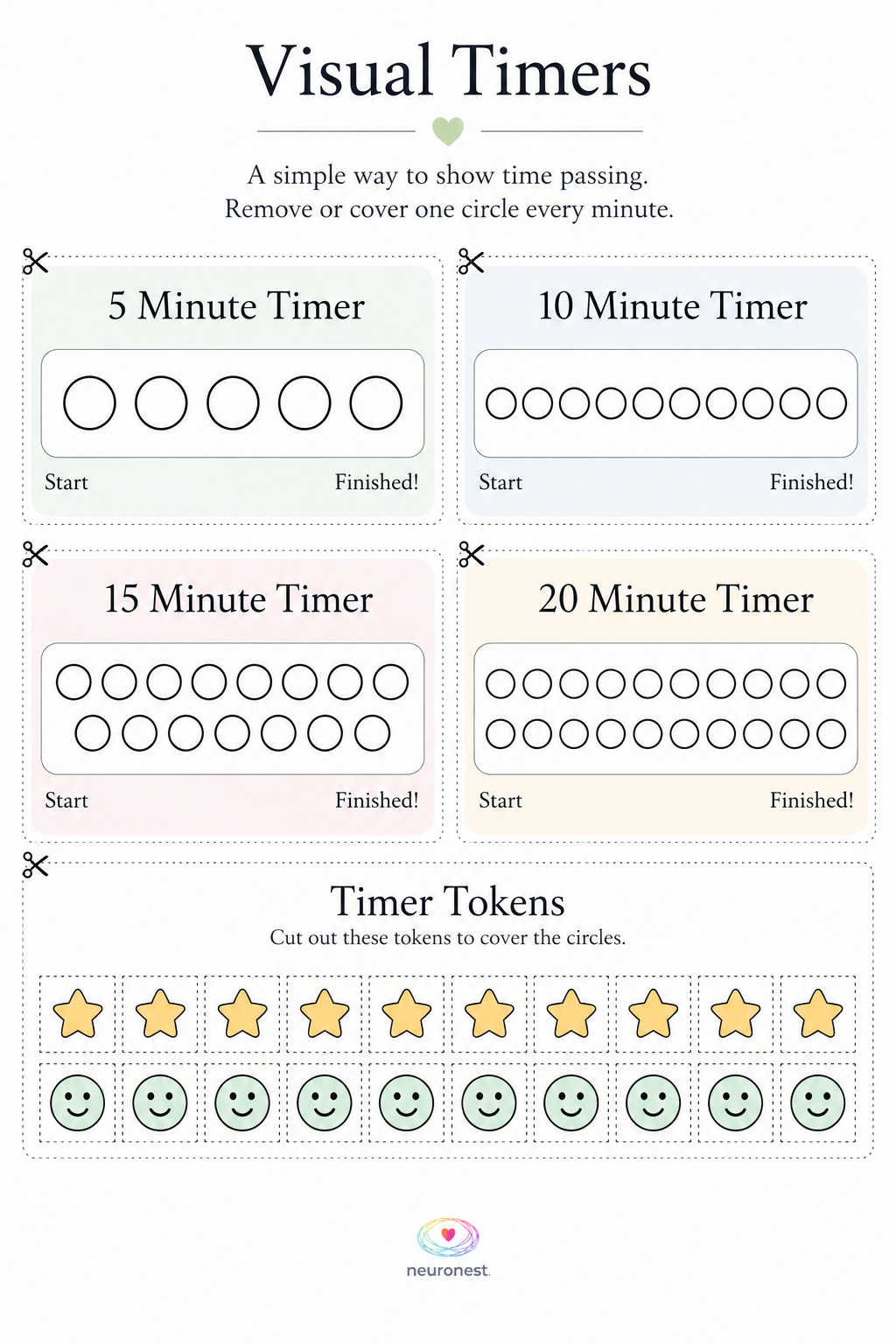
Visual Timer
Visual timers can make the passage of time easier to understand. This tool provides a clear, visual way to show your child how much time is left.
Many children benefit from knowing what to expect. These tools help create gentle structure without needing everything to be rigid or fixed.
Visual Schedule
A way to show the flow of the day using simple steps. This can reduce anxiety and support smoother transitions between activities.
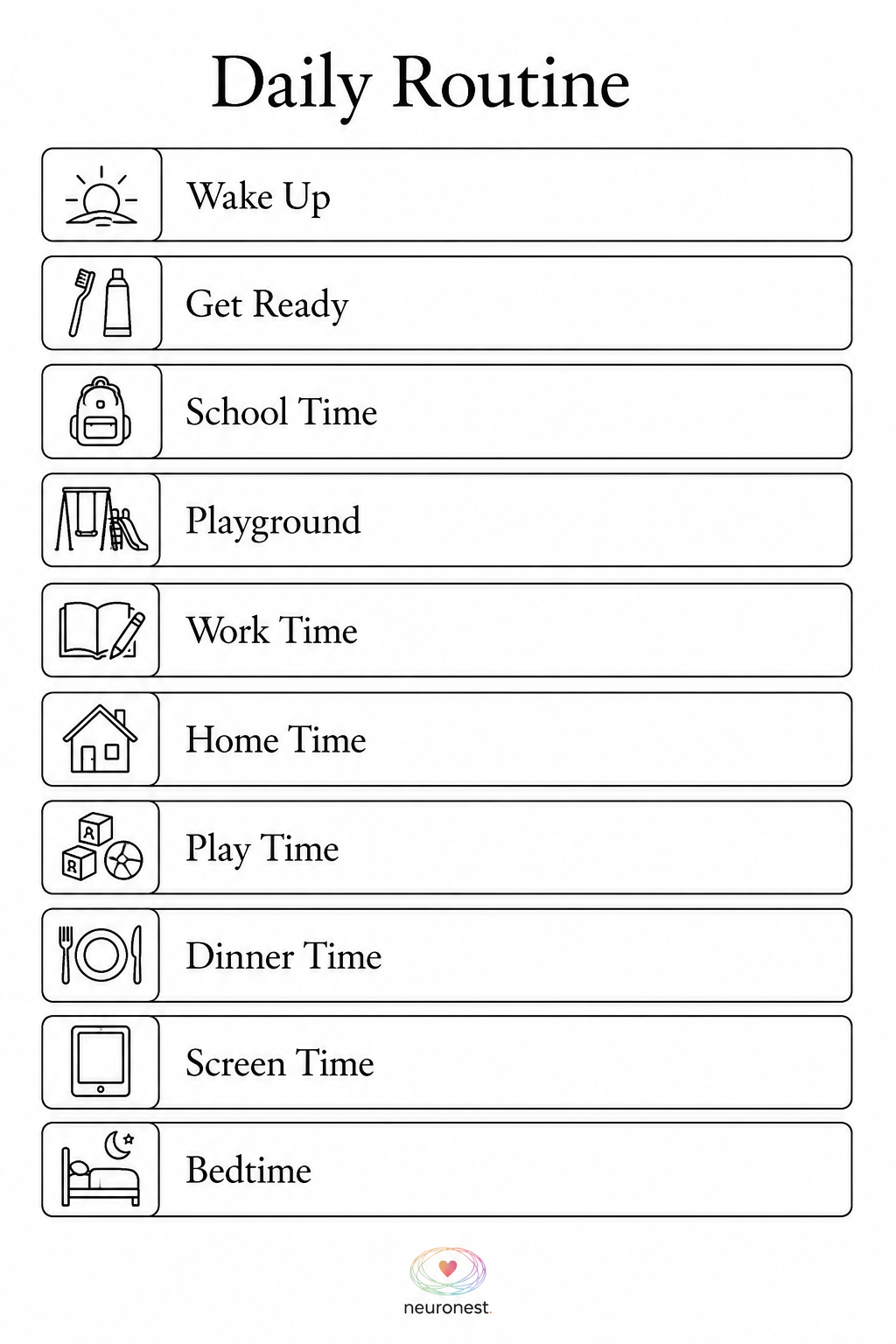
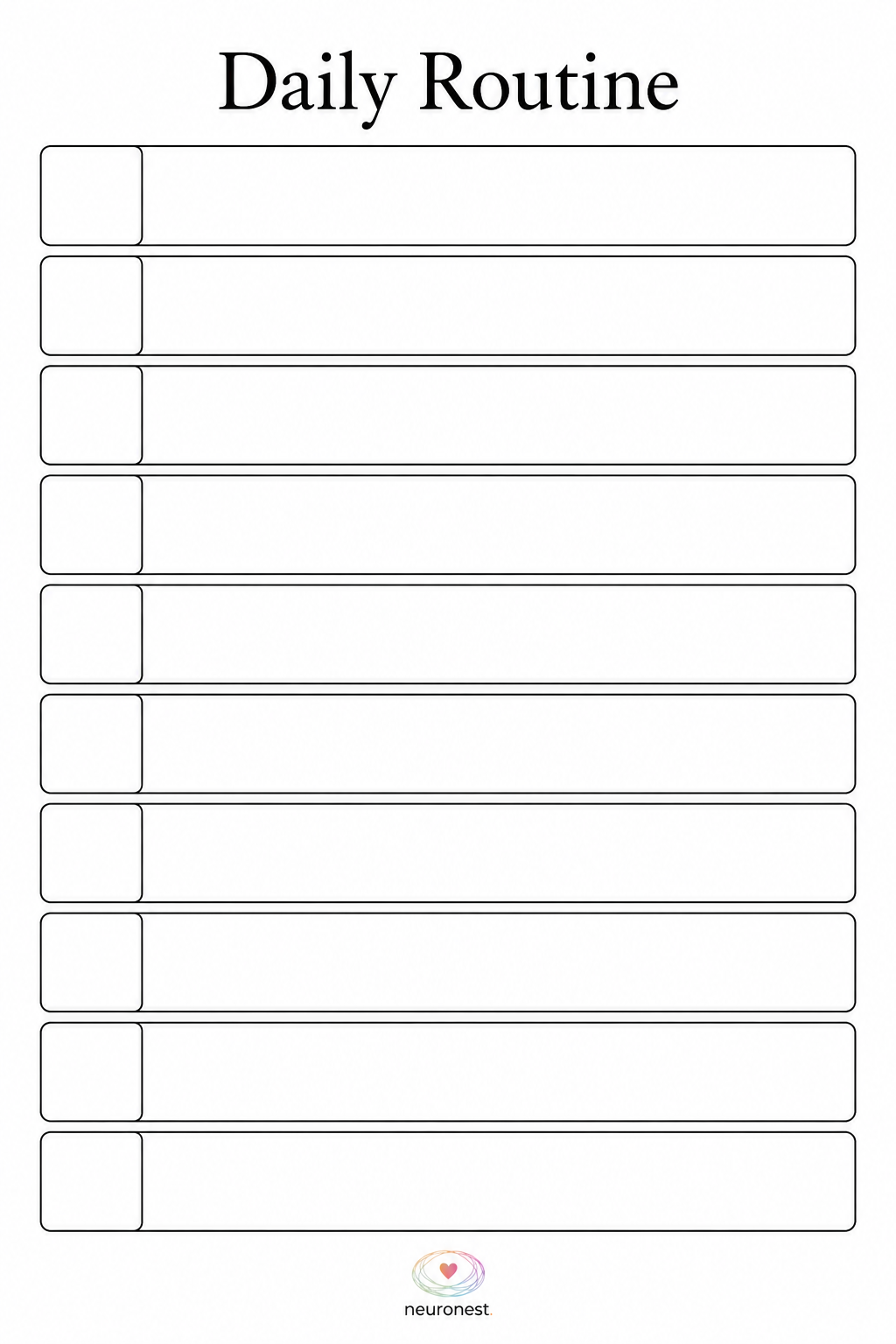
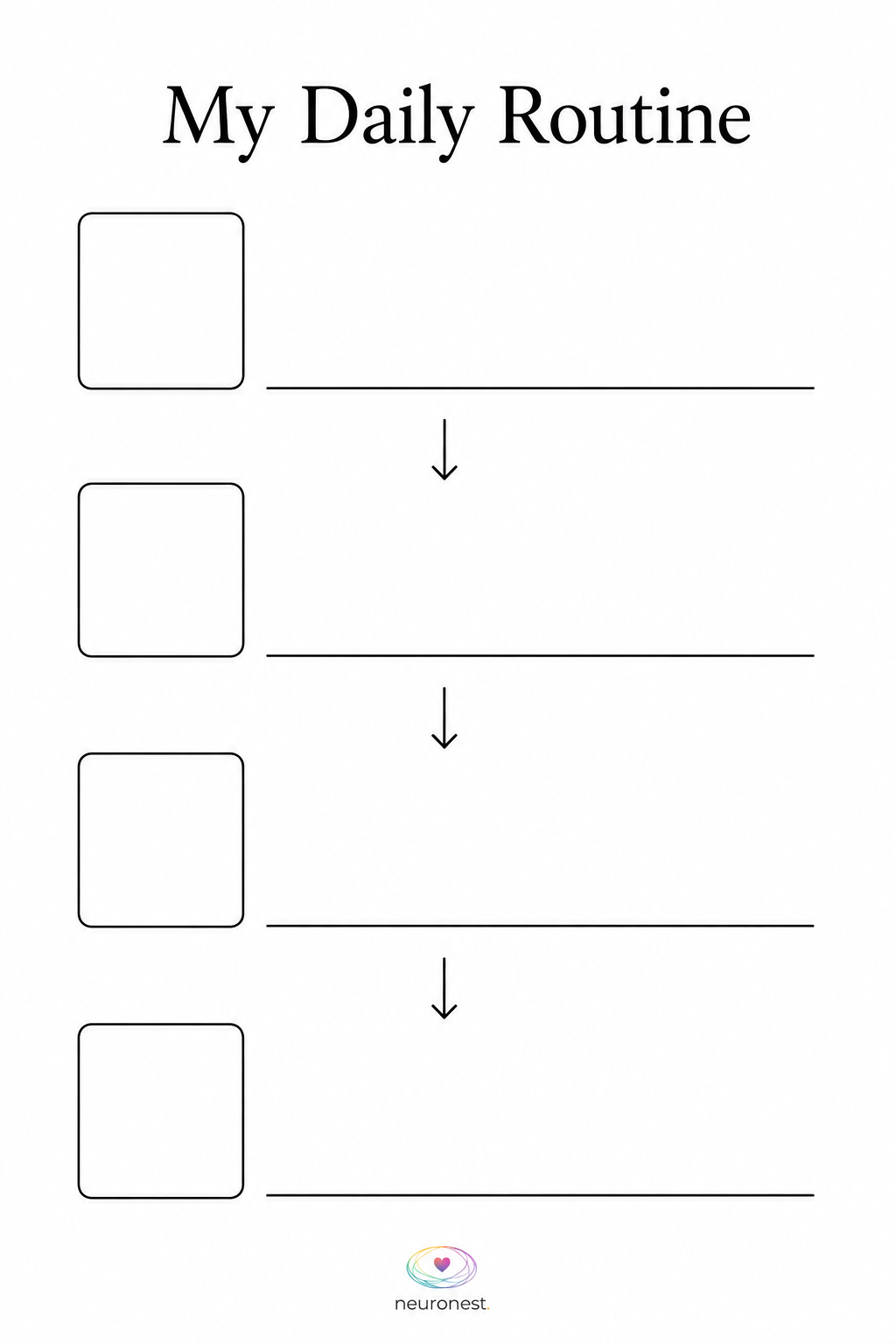
Daily Routine
A flexible way to build a daily rhythm that works for your child and your family. This doesn’t need to be followed perfectly – it’s simply a guide.

A simple visual to help your child begin to identify different emotions. You can use this during calm moments or gently during challenging times.
Feelings Board

Common Emotions Board

Social stories can help children understand and prepare for everyday situations, changes and unfamiliar experiences.
Looking for social stories to use now?
Autism Little Learners has a collection of social stories to help children understand everyday situations and what to expect.
A collection of practical information and resources for parents and caregivers of autistic children, particularly in the early years. Their parent resources cover areas such as communication, visual supports, routines, social stories, toileting, and everyday skills.
Visual Timer
A visual way to help children understand how much time is left during everyday activities and transitions. It can make changes and waiting feel more predictable and easier to understand.
Chewable Sensory Jewellery & Toys
A chewable option for children who seek oral sensory input or regularly chew on clothing, toys, or other objects. Choose an age-appropriate option designed specifically for chewing and always follow the manufacturer’s safety guidance.
Ear Defenders / Noise Reducing Headphones
Can help reduce overwhelming sounds in busy or noisy environments. They may be useful for children who find places such as shops, school, events or public transport difficult because of noise.
Portable Communication Cards
A portable way for children to communicate important needs when speaking isn’t possible or is difficult. Cards can provide simple visual choices such as help, toilet, finished, yes, no, or I need a break.
Emotions Keychain
A handy visual tool to help children communicate how they’re feeling, especially when finding the words can be difficult. Small enough to take with you, it can be useful at home, school or when out and about.
JAM Card
The JAM (Just A Minute) card can be a simple way to let others know that your child may need additional time, understanding, or support in certain situations. It can be particularly helpful when your child may not be able to explain their needs themselves.
Sunflower Lanyard
The Hidden Disabilities Sunflower lanyard can discreetly indicate that someone may have a hidden disability and could need additional patience, understanding or support. It can be useful when travelling, attending busy places or navigating unfamiliar environments.
Non-Verbal Emergency Tag
A simple way to communicate important information in an emergency when speaking may not be possible. This can help children and young people quickly explain that they are non-speaking and may need additional support.
Remember: these tools are here to support you – they are not something you have to get ‘right’. Every child is different, and it’s okay to take things slowly and find what works for your family.
Share Your Resources
Have teaching materials, activity ideas, or resources that have worked well for you? We’re building a community library where families and educators can share what works.
Need More Support?
Connect with qualified tutors and professionals, or explore our information hub for help and guidance.
